People ask me where the Greek touch comes from, as if it were a filter I apply at the end — a blue-and-white accent pillow dropped onto a neutral sofa. It is not. It is the lens through which I see everything, because I am Greek, and I am from Athina.
Athina shaped my eye
Athens — Athina in Greek, the city that taught me a room needs one quiet form — taught me that beauty and difficulty live in the same street. You walk past marble columns older than your country’s constitution and graffiti newer than last week. You eat figs from a market stall while sirens compete with church bells. I do not see proportion as decoration; I see it as survival. A room with one arch feels whole. A room with twelve competing focal points feels like noise.
I left Athina for Dubai, for love, for family, for the life I chose. Athina never left me. Every arch in Wafa collection is a doorway I still walk through in memory. Every travertine sphere is a moon I watched from a rooftop terrace while my grandmother told stories about the neighborhood before the cars came.
Not fusion — truth
When we edit furniture and decor for Gulf homes, we do not paste Greek symbols onto Arabic architecture like a tourist souvenir. We hold both truths: Mediterranean proportion — the calm of Cycladic lines, marble memory, stone that outlasted empires — and Gulf craft — hospitality made tactile, light that grazes rock at dusk, ritual objects that honour daily touch.
A travertine tray belongs to an island morning and a Dubai vanity at dawn. A lamp holds Mediterranean dusk and Gulf evening in the same glow. Culture becomes useful when you can feel it in your hands — not when it is printed on a poster.
The Greek touch in practice
What does this look like in a home? It looks like negative space — the Greek lesson that what you leave out matters as much as what you put in. It looks like honest materials: stone that shows its pores, wood that shows its grain, linen that softens with washing. It looks like ritual elevated to ceremony: the coffee served slowly, the table cleared before the meal, the light lowered at dusk because the day deserves an ending.
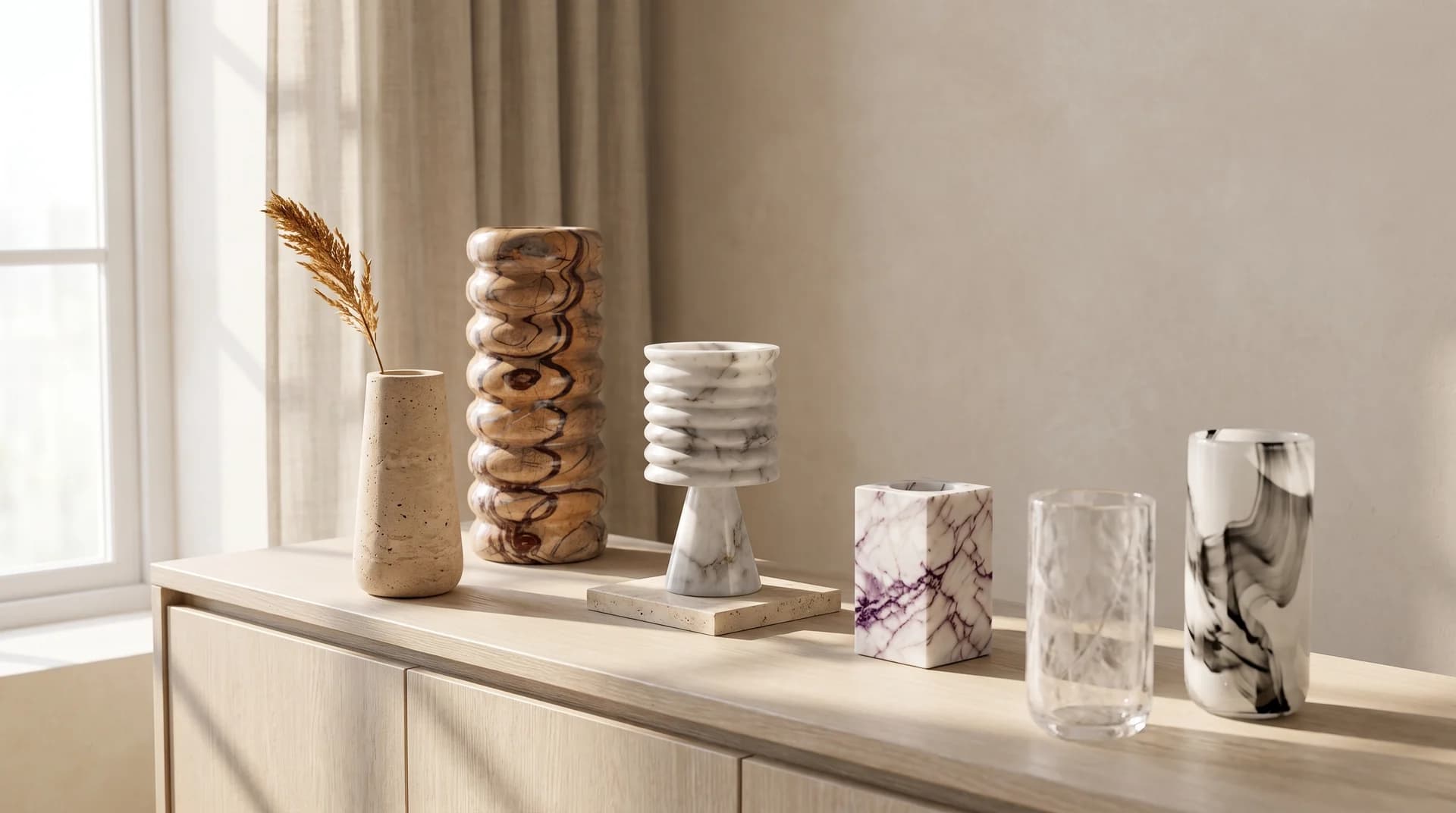
Greek restraint: enough is the point. One stem, one vessel, or silence. Wafa collection holds that enough — forms the aunt would place. Dusk is the hour Greeks call deilino, when the light turns gold and families come back together. The other moods we learned at home — the clearing before a meal, the gold hour — we are still making.
Teaching our kids
My partner and I teach the kids the Greek touch not through language drills alone — though they know the words for marble, light, enough — but through how we live. We visit Athina when we can. They run their hands along columns and ask why the stone is cool in summer. We tell them: because the earth remembers. Because some things outlast trends. Because their job is to choose what lasts and what means something.
The Greek touch is not an aesthetic. It is a way of holding permanence and pleasure in the same hand — and offering both to the family we are rebuilding.